

Aluminum Outdoor Kitchen Cabinets | Custom by DBM Factory


Aluminum Outdoor Kitchen Cabinets
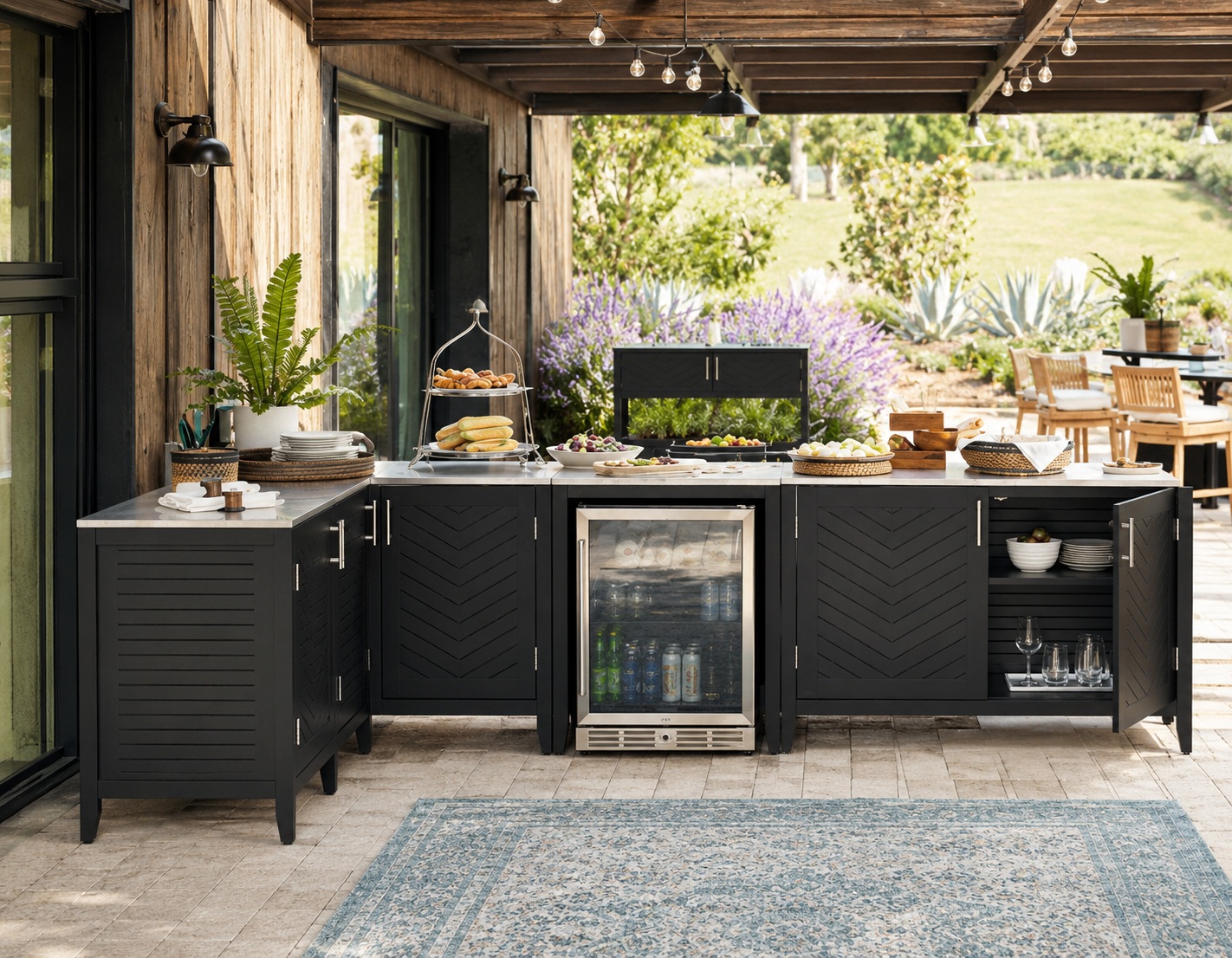
An aluminum outdoor kitchen sits lighter than steel. The frame weighs less on a terrace slab or rooftop deck. Powder-coat color lets the cabinet match the railing, the planters, or the trim rather than reading as a default stainless box. It is the outdoor kitchen for the home that wants the cooking space to belong to its terrace.
DBM designs and produces each aluminum outdoor kitchen run around your project. Share a kitchen plan, a site photo, or a reference picture. We turn it into a working drawing, then build the cabinet bodies, doors, and counter frames ready for shipment.
Choose the Right Aluminum Outdoor Build
Anodized Finish — Silver / Bronze / Champagne
Anodized aluminum carries a thin oxide layer that resists weather while keeping a metallic face. Silver for the clean modern reading. Bronze and champagne for the warmer outdoor palette where the kitchen should not read cold.
Powder-Coat Color — Matte Black / White / Custom
Matte black against pale paving and timber decking. White for the bright coastal terrace. Custom RAL color where the outdoor kitchen needs to match railing, pergola, or planter color across the terrace.
Door Style — Slab / Slatted / Drawer
A clean slab door for the modern terrace cabinet. A slatted door where the cabinet needs some airflow. Drawer fronts where utensils and tools have to be reachable without bending into a deep cabinet box.
Hardware — Bar Pull / Hidden
A long bar pull in matte black or anodized aluminum for the everyday outdoor cabinet. Hidden grip detail along the top of the door for the cleaner, fully handleless reading.
Where Aluminum Outdoor Kitchens Fit — Four Common Project Types
Villa Terrace
A covered terrace at the back of the villa, an outdoor dining room with a built-in grill. Aluminum carries less weight onto the terrace slab and the powder-coat finish can match the railing across the same garden.
Apartment Rooftop
An apartment rooftop terrace where load on the slab is part of the brief. The lighter aluminum cabinet is the common pick when the architect or contractor is looking at structural limits and access for materials.
Coastal Modern Home
A coastal modern home with a deck or pool patio. Anodized or powder-coated aluminum stands up to the salt air while keeping the cabinet color soft against the surrounding palette.
Vacation Residence
A weekend home, cabin, or rural property where the outdoor kitchen sees seasonal use. Aluminum holds up across the off-months and reopens for the season without the surface damage that timber can carry.
From Sketch to Site — Three Stages
Share a kitchen plan, a site photo, or an elevation — that’s enough to start. We turn it into a working drawing covering cabinet box sizes, door layout, and openings for the grill and appliances. The drawing also shows how the run meets the counter.
Cabinet bodies, doors, and counter frames are trial-fit and photographed in our Guangdong workshop before crating. Each part comes labeled and finish-protected, so on-site work is typically setting and adjusting rather than field-fabricating.
Wooden crates built for ocean freight, packed in the order your installer will set the kitchen. Shipped to 60+ countries — including the USA, Australia, the EU, and across Asia.
After delivery, your contractor or installer handles fitting. We provide an assembly guide and a step-by-step video. Where local installation is available in your region, we can help you find a vetted installer.
Aluminum Outdoor Kitchen Cabinets
Up on the Roof — When Weight, Access, and Wind Set the Brief.
A rooftop terrace is a wonderful place to cook and a demanding place to build. Every kilogram that lands up there has to be carried up and then supported below. The structure underneath carries a finite load, and the deck cares about every cabinet you add.
Owners on a roof deck or an elevated terrace reach us with a familiar tension. They want a generous cooking run, yet the building imposes a strict weight allowance. So the brief is a balancing act from the first sketch. It asks for presence on the deck without an excessive load beneath it.
Why Lighter Metal Answers the Elevated Brief.
Aluminum carries a clear advantage when the deck below has a defined limit. The cabinet bodies weigh substantially less than an equivalent steel configuration. So the same generous run imposes a smaller load on the structure, which is precisely the constraint a rooftop project lives with.
The weight question rarely arrives on its own, though. A licensed structural engineer in your jurisdiction reviews what the deck can genuinely support. We supply a clear drawing of the cabinet run and its general weight, so that review starts from accurate information rather than a guess.
The lighter material then pays a second dividend during the build. A crew lifts and positions an aluminum module more readily than a heavier steel one. On a roof deck reached by a tight stair or a service lift, that handling difference genuinely matters. Fewer hands and less lifting gear are needed to move each module into place.
The Three Constraints an Elevated Deck Imposes.
Getting the Modules Up There.
A rooftop run has to physically reach the rooftop before it serves anyone. A service lift, a stairwell turn, or a narrow doorway can each cap the module dimensions you can move. So we ask about the access route at drawing stage and size the modules to negotiate it. A run that arrives in liftable pieces beats a single body that jams in the stairwell.
Holding Steady in the Wind.
Wind behaves more aggressively up high than at ground level. An exposed terrace can see real uplift pressure across a tall cabinet face or a bar back. So we detail anchoring points into the configuration, so your installer can fix the run down to the deck structure. The cabinet stays put through a gust instead of shifting on an open roof.
Spreading the Load Sensibly.
A point load concentrates weight, while a spread load shares it across the deck. So we keep the run continuous and seat the heavier appliances thoughtfully along its length. The configuration distributes its weight rather than driving it through a couple of concentrated feet. Your engineer still makes the final structural call, with our drawing in hand.
What Coordination Looks Like for a Roof Deck.
Drawing-First Coordination begins with the access route and the load picture. We confirm the lift dimensions, the stairwell turns, and the deck's general weight allowance before anyone cuts metal. The working drawing then sets module sizes that travel up cleanly and anchoring points that hold against the wind. We resolve the elevated puzzle on paper first.
Trial Assembly Before Packing then stands the whole run up on our Guangdong workshop floor. We fit the bodies, doors, and counter frames, and we confirm the anchoring details work as drawn. Then we take it down and label each part. The build on your terrace becomes an ordered bolt-together job, not a high-up improvisation.
Export-Ready Crating packs the modules in the order your installer will carry them up and set them. We seat the heaviest pieces low and protect the powder-coat faces for the long ocean leg. The crate arrives ready to open, sort, and lift to the roof against the drawing.
What to Send Us About Your Terrace.
A photo of the terrace and a rough run length give us a solid starting point. Then describe how the modules will reach the deck, whether by service lift, stairwell, or external hoist. Note any tight doorway or landing turn along that route, since it caps the module dimensions.
One more detail rounds out the picture for us. Tell us how exposed the terrace is to wind, and flag any weight allowance your engineer has already specified. From there we turn your notes into a working drawing and a run built to ship.
After delivery, fitting is on your side. On site, your contractor or installer handled fitting directly from our drawings, with our assembly guide and step-by-step video to follow — or use your own local installer where needed.
Chat on WhatsApp →Compare the Stainless Steel Outdoor Kitchen Cabinets → · see the Outdoor Bar Cabinet → · or browse the full Outdoor Kitchen Cabinet range →