

Straight Metal Staircase | Custom by DBM Factory


Straight Metal Staircase
A straight metal staircase is the quiet workhorse of a building — one clean run from floor to floor, no curves, no fuss. It sits well in new builds, loft conversions, and working interiors where the stair is part of the architecture, not the headline.
We design and build each straight metal staircase around your drawing. Share a sketch, a CAD, or a photo of the opening, and we turn it into a working drawing and a stair ready for shipment.
Match the Metal to the Room
Galvanized Steel — Service & Conversion Runs
Zinc-coated for long rust resistance. The everyday durable choice for back-of-house entries, conversion runs, and basements that see real use.
Powder-Coat over Steel — Designed Interiors
When the stair lives in a finished room, a powder-coat in your chosen colour pulls it into the palette. Matte black, soft grey, or a custom RAL on request.
Stainless Steel — Long-Term Polished Look
Brushed or polished stainless for stair runs that need to look new for years. Common in apartment lobbies and coastal homes where staining isn't an option.
Tread Choice — Wood / Stone / Steel Pan
Solid timber treads for a warm interior, stone for a designed villa run, or steel pan for service stairs. Each tread option is fitted to the same stringer in the workshop.
Where It Fits — Four Common Project Types
New Home Build
A custom straight metal staircase drawn into the architect's plans — a clean run between floors with the finish chosen to match the interior. The structural metal disappears under the wood or stone tread, or stays visible as a designed feature.
Apartment & Condo
Lobby runs, mezzanine access, internal duplex stairs. Powder-coat or stainless gives a polished look that ages well in shared and high-use spaces.
Batch Renovation & Multi-Unit Development
When the same straight metal staircase repeats across units — townhouse rows, serviced apartments, hotel back stairs. We build to one drawing and repeat to the same finish across the run.
Loft & Conversion Projects
Warehouse-to-loft, old shop into living space, attic to second floor. A straight single-flight steel staircase fits a tight floor plan without eating the room.
From Sketch to Site — Three Stages
Share a sketch, photo, or CAD — that's enough to start. We turn it into a working drawing covering the run length, stringer type, tread layout, and the key connection details at top and bottom.
Every staircase is fully dry-assembled and photographed in our Guangdong workshop before being taken apart for shipping. Each component arrives labeled, so on-site assembly is straightforward — typically bolt-together, not field-welding.
Wooden crates built for ocean freight, packed in the order your installer will assemble. Shipped to 60+ countries — including the USA, Australia, the EU, and across Asia.
After delivery, your contractor or installer handles fitting. We provide an assembly guide and a step-by-step video. Where local installation is available in your region, we can help you find a vetted installer.
Straight Metal Staircase
When the Flight Reads Against a Feature Wall — the Open-Riser Brief.
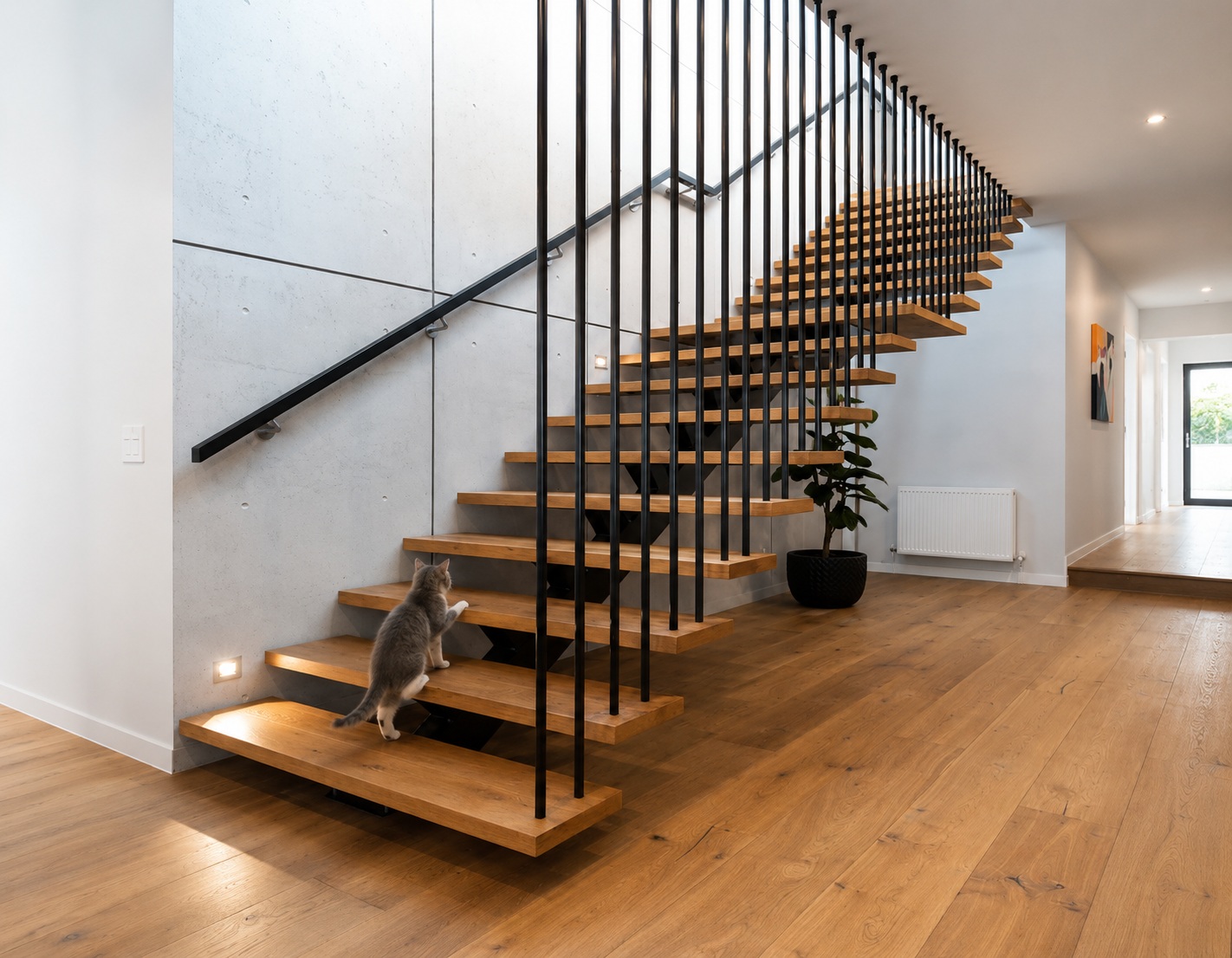
Some flights are meant to be seen. A single open-riser run climbs along a feature wall in the entry, and the owner wants daylight to pass straight through the structure. Closed risers would interrupt that light, so the brief turns on the configuration between the treads, not simply on the run itself.
Owners typically reach us once the wall has become the architecture of the room. A plaster panel, a run of natural stone, or a tall window already defines the space. The staircase must climb across that surface without concealing it, so the proportion of each open gap has to read as part of the wall, never as a barrier layered over it.
Open Riser or Closed — the Choice That Shapes the Room.
The open riser leaves a clear gap beneath each tread, so the eye travels through the flight to the wall behind. The room feels more generous, and the daylight penetrates deeper into the floor plan. That single characteristic is why an open configuration suits a feature wall so naturally.
The trade-offs are practical, and they deserve an early conversation. An open riser presents a continuous gap, so a household with very young children may prefer a closed face or a tighter dimension underfoot. Open treads also let small objects slip through, which matters more on a busy daily staircase than on a quiet display flight.
So the right decision rests on how the entry genuinely lives. Where the wall and the natural light lead the design, the open riser typically earns its place. Where the same flight carries heavy daily traffic alongside small children, a closed or partially closed riser may serve the household better, and we discuss every option before a single line is drawn.
How the Same Flight Flexes Across Walls and Rooms.
A Solid Wall vs a Glazed One.
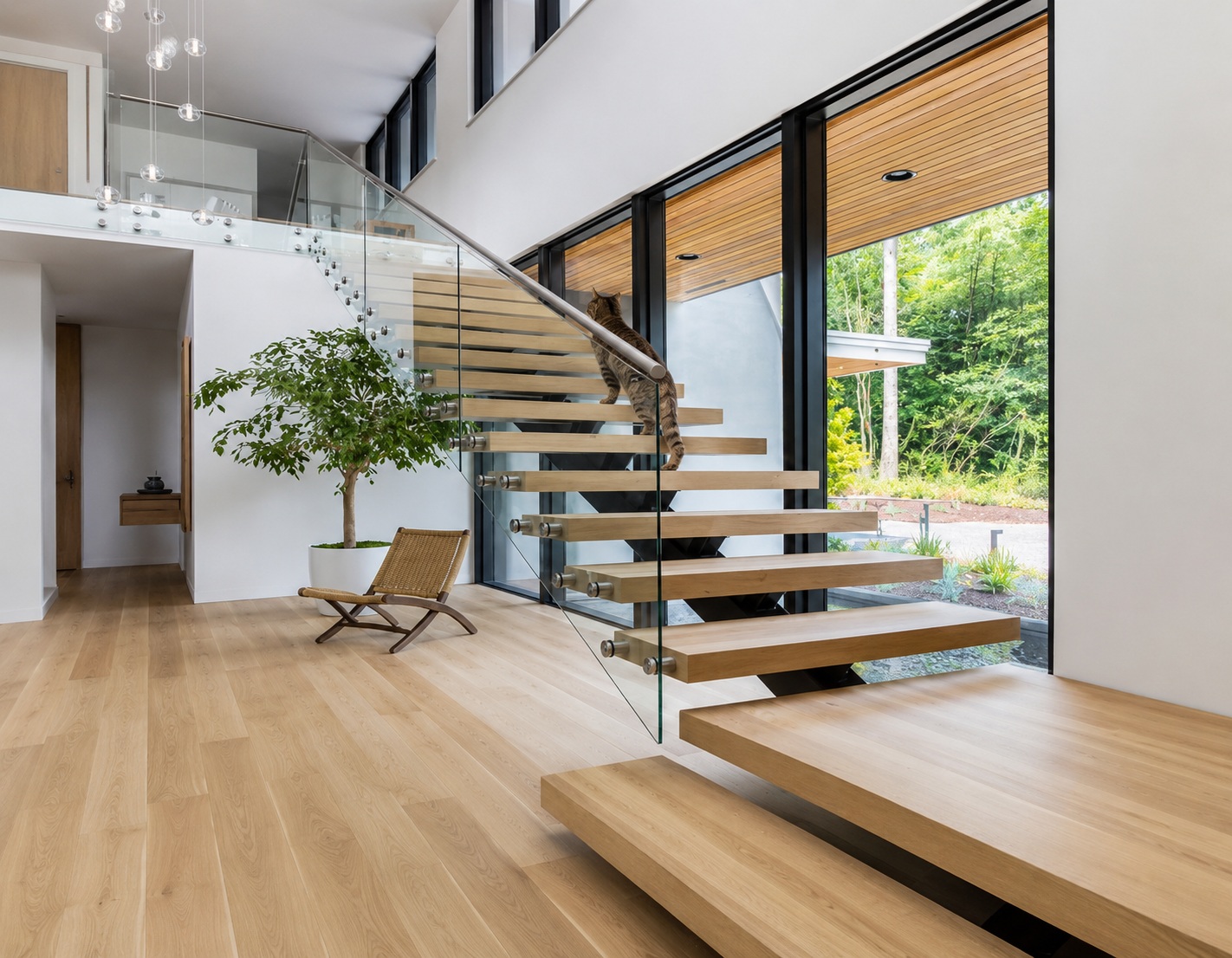
The surface behind the flight establishes the whole atmosphere. Against a solid plaster or stone wall, the treads cast a soft shadow line that shifts across the day. Against a tall window, the identical open treads let the view stay clear from the floor to the ceiling. The flight holds its configuration either way, while the wall behind it determines how the climb is read.
Wall-Mounted vs Free-Standing.
A cantilever-style mono-stringer can hug one wall, so the treads appear to project straight out of that surface. A free-standing twin stringer instead stands clear in the room, with both sides open to the air. We resolve the structural support route on the working drawing, because a wall-mounted flight requires concealed blocking inside the wall that a free-standing configuration does not.
A Single Home vs Repeated Units.
A one-off villa flight gets tuned precisely to one wall, one tread material, and one sightline. A multi-unit development quietly reverses that logic. The same stringer specification and tread count then repeat from unit to unit, so an owner-developer can order a matched run of open flights in one batch. We settle the drawing once, and carry it cleanly across the entire set.
What Coordination Looks Like for an Open Flight.
Drawing-First Coordination begins with the wall, not the staircase. We establish the landing heights, the wall finish, and any structural blocking the support requires before anyone cuts metal. An open run leaves nowhere to conceal a rough joint, so the working drawing resolves the tread spacing and the wall fixing specification on paper first.
Trial Assembly Before Packing then stands the whole flight upright on our Guangdong workshop floor. We verify the tread line, confirm each open gap reads consistently, and photograph the result before we take it down. We label every component as it comes apart, so the build against your wall becomes a clean bolt-together operation rather than a field weld in a finished room.
Export-Ready Crating packs the parts in the order your installer will raise them. We protect the visible tread faces and the coated stringer against knocks for the long ocean leg. The crate lands ready to open and stack, with the heaviest pieces seated low for a safe lift.
What to Send Us About Your Wall.
A photo of the wall and a rough sketch give us plenty to begin with. Add the floor-to-floor height, which is simply the climb from the lower surface up to the upper one. Then note the run length you can give the flight, measured along the wall it will follow.
One more line helps us read the look you want. Tell us the wall finish behind the stair, and whether you lean toward an open or a closed riser. From there we turn your notes into a working drawing and a flight ready to ship.
After delivery, fitting is on your side. On site, your contractor or installer handled fitting directly from our drawings, with our assembly guide and step-by-step video to follow — or use your own local installer where needed.
Chat on WhatsApp →Compare the Straight Steel Staircase → · see the Industrial Stairs → · browse the full Straight Staircase range → · or explore all our staircases →