




Sliding Door Wardrobe | Custom by DBM Factory


Sliding Door Wardrobe
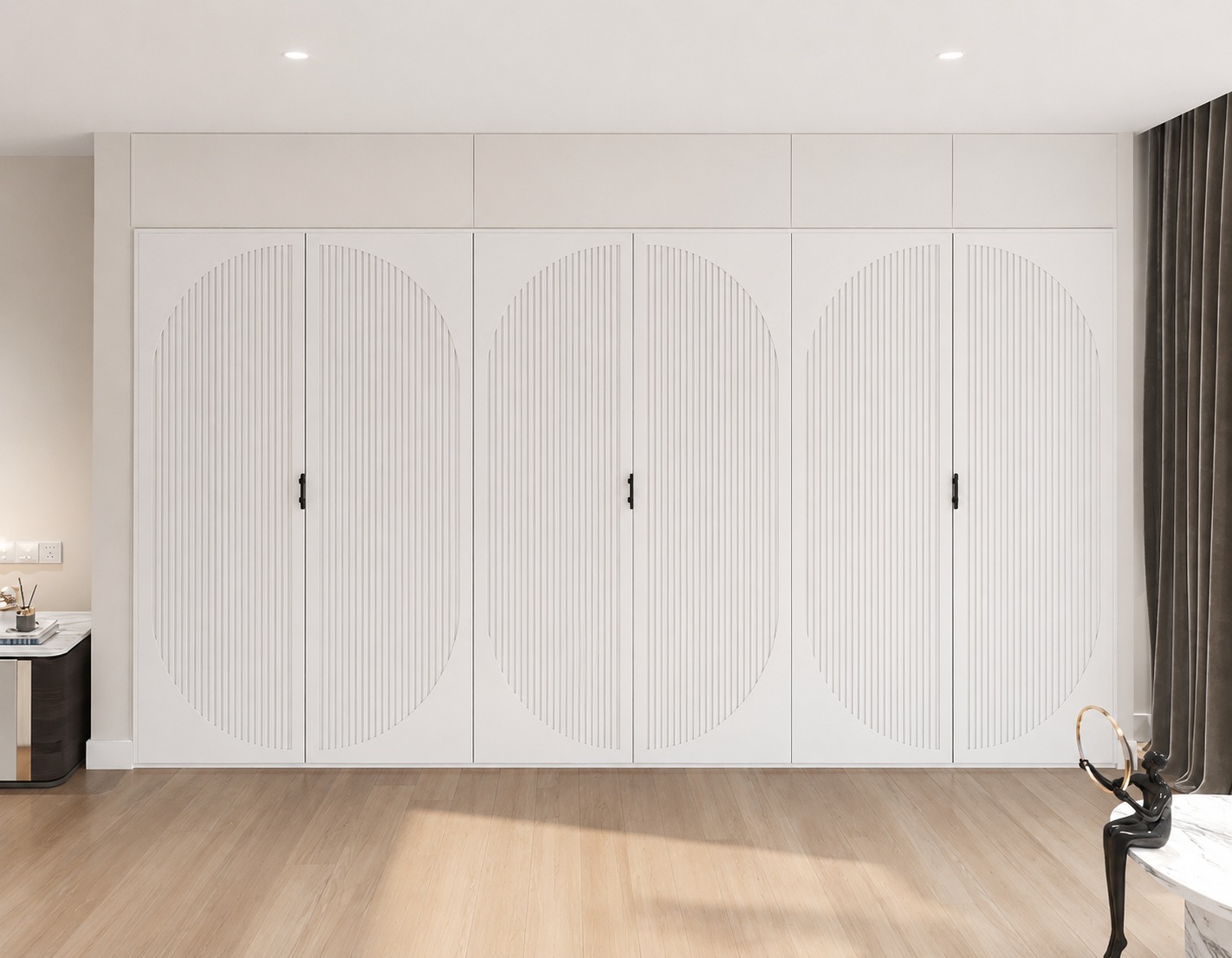
A sliding door wardrobe saves the swing space a hinged door would take. The doors run on a top track and glide sideways — useful in apartments and compact bedrooms where the bed sits close to the wardrobe wall. It’s the closet that fits where a hinged wardrobe simply will not.
We design and produce each sliding-door wardrobe around your project. Share the opening width, ceiling height, and a designer reference. We turn it into a working drawing and build the cabinets and door panels ready for shipment.
Save the Swing, Keep the Look
Sliding Track — Top-Hung / Bottom-Rolling
Top-hung tracks keep the floor line clean and let dust pass underneath — the common pick for residential bedrooms. Bottom-rolling rails carry heavier door panels where the doors are tall or fully glazed.
Door Material — Wood / Laminate / Tinted Glass
Veneered wood doors to match the bedroom palette. Painted laminate where the doors should read as the wall. Tinted or fluted glass panels framed in slim aluminum where the closet is part of the design.
Mirror Option — Full-Door Mirror Panel
A full-height mirror on one or both sliding panels brightens the bedroom and removes the need for a separate stand-up mirror. Tempered for safety. Common in apartments and renovation refreshes.
Soft-Close Hardware — Dampers & Guides
Dampened sliders pull the door the last few centimetres so it doesn’t slam into the side jamb. Felt-lined floor guides keep the bottom edge running true. Sound and feel matter every time someone opens the wardrobe.
Where It Fits — Four Common Project Types
Apartment Bedroom
The bed is close to the wardrobe wall, so swing space is the limit. Sliding panels solve that. A mirrored door on one side brightens the room and saves the floor space a freestanding mirror would take.
Compact New Home
Drawn into a smaller secondary bedroom where the floor plan cannot afford a hinged-door wardrobe. Slim aluminum-framed glass panels keep the room feeling open while the closet does the heavy lifting.
Renovation Refresh
The old hinged closet replaced with a sliding-door system that fits the same opening — same footprint, more usable floor. Painted laminate or wood-veneer panels finished to match the refreshed bedroom palette.
Vacation Residence
A holiday-house bedroom where guests need usable storage without a closet that crowds the room. Top-hung sliders with a softer wood-tone panel keep the room reading as a retreat rather than a hotel cupboard.
From Sketch to Site — Three Stages
Share the opening width, ceiling height, and a designer reference — that’s enough to start. We turn it into a working drawing for the sliding-door wardrobe. It covers the track type, door panel sizes, and the bulkhead clearance your contractor will need.
Every cabinet and door panel is fully assembled and photographed in our Guangdong workshop before being taken apart for shipping. Tracks, rollers, and hardware come matched and labeled, so on-site assembly is straightforward — typically bolt-and-cam, not site-cutting.
Wooden crates built for ocean freight, packed in the order your installer will assemble. Shipped to 60+ countries — including the USA, Australia, the EU, and across Asia.
After delivery, your contractor or installer handles fitting. We provide an assembly guide and a step-by-step video. Where local installation is available in your region, we can help you find a vetted installer.
Sliding Door Wardrobe
When the Bed Sits Close to the Wall — Storage That Opens Where a Hinged Door Cannot.
In a tight bedroom the bed often sits only a stride from the wardrobe wall. A hinged door would swing straight into the mattress, so it either cannot open fully or it forces the bed away from its natural position. The narrow gap between bed and wall is the whole problem, and it rules out the obvious wardrobe.
Owners reach us once the room arrangement is fixed and the storage still has to fit. The bed cannot relocate without losing the window or the doorway, yet the wall calls for a full run of wardrobe. So the brief is clear. They want doors that open without any swing clearance, so the wardrobe works hard while the circulation around the bed stays comfortable.
Why Sliding Panels Win the Tight Bedroom.
The clearance in front of the wardrobe is the deciding factor. A hinged door needs that whole arc of floor to open, and in a tight bedroom the bed has already claimed it. A sliding panel runs sideways on its track and needs no clearance at all, so the doors open even when the bed sits a hand-width away.
That sideways motion is what makes the configuration possible. The panels pass in front of one another along the run, so the wardrobe can span the full wall while the floor in front stays free for the bed. The room keeps its circulation, and the storage loses nothing to the layout it sits within.
The trade-offs stay honest, as always. A sliding system opens only part of its width at once, since one panel always overlaps another, and a very wide opening needs careful panel division to stay easy to use. Where the wall is short, two panels suit it; where it runs long, three or more keep each door a comfortable weight. We balance the panel count against your opening, well before any panel is cut.
How the Slider Adapts to the Bedroom.
The Panel Division Comes First.
The width of the opening decides how many panels the run carries. We divide the elevation so each door stays a comfortable weight to slide and so the most-used section sits where you reach it first. A two-panel split suits a shorter wall; a three-panel configuration suits a longer one, keeping the overlap modest and the access generous.
The Track Choice Comes Next.
A top-hung track keeps the floor line clean and lets the panels glide above a slim bottom guide, the common choice for a residential bedroom. A heavier mirrored or fully glazed panel may require a bottom-rolling rail that carries the additional weight. We specify the track to the door material and the run length, so the operation stays smooth across the whole opening.
The Mirror and Light Come Last.
A tight bedroom often has no floor space for a separate stand-up mirror. A full-height mirror on one sliding panel solves that and bounces daylight back across the room, so the space reads larger than its footprint. We temper the mirror panel for safety and place it where its reflection extends the view rather than the wall.
What Coordination Looks Like for a Tight-Bedroom Slider.
Drawing-First Coordination begins with the opening and the room around it. We confirm the wall length, the ceiling height, and how close the bed sits to the wardrobe before anyone cuts a panel. A tight bedroom leaves no tolerance for a guess, so the working drawing settles the panel division and the track specification on paper first. We return it for you to check against the real layout.
Trial Assembly Before Packing then stands the full wardrobe and its panels upright on our Guangdong workshop floor. We hang the doors on the track, slide each panel across the run under load, and confirm the soft-close dampers catch cleanly at the jamb. Then we dismantle the unit, label every carcass, panel, and track section, and record the sequence it follows back together under your roof.
Export-Ready Crating packs the components in the order your installer will set them, the track and rollers matched and grouped with their panels. Mirror and glazed panels travel with foam and corner protection for the long ocean passage. The shipment lands sorted, ready to lift, position, and assemble straight against the drawing.
What to Send Us About Your Bedroom.
The opening dimensions give us the wardrobe wall: the width and the ceiling height. A quick floor plan or a photo from the doorway shows us where the bed sits and how much clearance stays in front. Note any window, radiator, or doorway the run has to work around.
One more note helps us finish the picture. Tell us the door material you would like, whether wood, laminate, glass, or a mirror panel, and how the room is used day to day. From there we turn your notes into a working drawing and a sliding-door wardrobe ready to ship.
After delivery, fitting is on your side. On site, your contractor or installer handled fitting directly from our drawings, with our assembly guide and step-by-step video to follow — or use your own local installer where needed.
Chat on WhatsApp →Compare the Freestanding Wardrobe → · see the Walk In Closet System → · browse the full Closet & Wardrobe range → · or explore all our cabinetry →