

Aluminum Freestanding Pergola | Custom by DBM Factory


Aluminum Freestanding Pergola
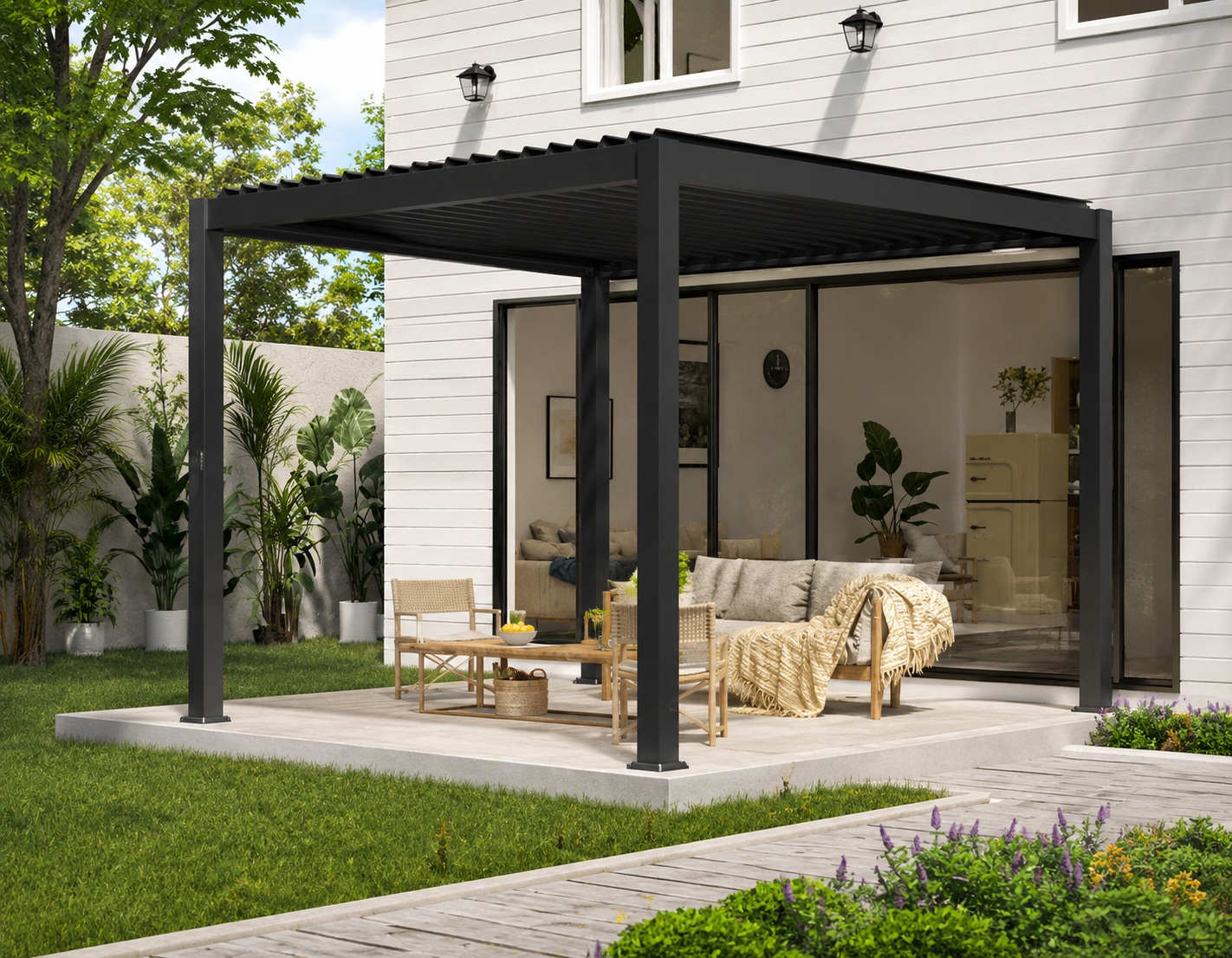
A freestanding aluminum pergola sets a separate outdoor room in the garden, beside the pool, or out in the lawn. It stands on its own four posts, away from the main building. It defines a place to gather without needing to lean against the house. The aluminum frame keeps the lines clean and the maintenance low across seasons.
We design and produce each freestanding pergola around your project. Share a sketch, a site photo, or a design reference. We turn it into a working drawing, fabricate the frame, posts, and roof, and prepare everything for shipment.
Choose the Right Build for Your Setting
Post Finish — Powder-Coat Palette
Matte black anchors the structure visually in lawn or garden settings. Bronze warms a stone or timber palette. Custom RAL on request when the project specifies the exterior colors.
Span & Footprint — Per Drawing
Small dining canopy for two posts, or larger lounge-and-bar footprint with four. Final span, post layout, and base-plate sizing are set on the working drawing so it sits true on the chosen pad.
Roof Option — Slat or Louver
Fixed aluminum slats for the classic open-beam look. Adjustable louvers where the owner wants to shape shade and shelter on demand. Both share the same frame.
Drainage Path — Concealed in Posts
Water from the roof routes through the perimeter beam and down through the post interior — out of sight from the gathering area. Wind referenced to AS 1170.1 on Australian drawings.
Where It Fits — Four Common Project Types
Villa Garden
A defined gathering place out in the garden away from the house. A long dining table beneath an aluminum slat roof, or a lounge cluster under adjustable louvers. Matte black or bronze finishes anchor it in the landscape.
Estate Grounds
Larger grounds where the pergola becomes a destination point rather than a patio cover. Wider spans, four-post footprints, and a custom finish to match other built structures across the property.
Resort Property
Owner-operated resort homes and private retreats where guests gather pool-side or garden-side. Aluminum handles outdoor exposure with minimal upkeep between bookings.
Vacation Entertaining
Second-home or short-stay properties where the owner hosts in the outdoor space. The freestanding form lets the pergola sit at the best part of the lot, not bound to the position of a wall.
From Sketch to Site — Three Stages
Share a sketch, site photo, or design reference — that’s enough to start. We turn it into a working drawing for the pergola, covering the span, post positions, roof option, and the base-plate detail your installer will need.
Posts, beams, roof slats or louvers, and hardware are fully assembled and photographed in our Guangdong workshop before being taken apart for shipping. Each component comes labeled, so on-site assembly is straightforward — typically bolt-together, not field-welding.
Wooden crates built for ocean freight, packed in the order your installer will assemble. Shipped to 60+ countries — including the USA, Australia, the EU, and across Asia.
After delivery, your contractor or installer handles fitting. We provide an assembly guide and a step-by-step video. Where local installation is available in your region, we can help you find a vetted installer.
Aluminum Freestanding Pergola
On an Open, Windswept Lot — Where the Structure Stands Alone Against the Weather.
Some gardens have nothing to hide behind. The frame stands out in the open, on a hilltop lawn or a bare rural plot, with no building next door to break the weather. The wind arrives across the whole site, and the owner still wants a sheltered place to gather under it.
Owners usually reach us once the position is set and the exposure becomes plain. A frame tucked against a house borrows the shelter of that wall. A detached one out on open ground gets no such help. So the brief carries an extra demand. The frame has to stay steady through the strongest wind the site can throw at it.
Why the Open Site Drives the Engineering.
Exposure is the governing condition here, and the frame profile is the answer to it. A sheltered patio sees a gentle, broken breeze, so the posts and beams stay slim. An open lot delivers the full force of the wind onto every surface, so the frame members grow to suit. The same outward look can hide a much heavier frame underneath.
Wind acts on a roof in two ways, and both matter on an exposed site. It pushes sideways against the posts, and it lifts upward beneath the roof like a wing. The standing frame therefore needs to resist both overturning and uplift at once. We size the post wall thickness, the beam depth, and the base connection against the wind zone the site sits in.
The trade-offs stay honest, as ever. A heavier profile and a deeper footing cost more than a light garden canopy, and the frame reads a little more solid. Where the site sits open to the weather and the owner wants confidence through a winter gale, though, that engineered configuration typically justifies the difference.
How the Exposed Site Shapes the Build.
The Wind Zone Comes First.
An exposed site sits in a higher wind category than a sheltered suburban garden. We check the relevant wind-load tables for your region against the frame members before anyone cuts metal. The drawing records the profile sizes and the connection detail the build depends on, so the frame matches the exposure rather than a generic catalogue spec.
What the Posts Stand On.
A freestanding frame carries every wind load through its four posts into the ground. On open ground that connection becomes the key detail. We draw a base-plate set out for a concrete footing, with the anchor pattern and clearances marked on the drawing. Your engineer confirms the footing size for the local soil, since the ground conditions sit beyond what we can check from the workshop.
An Open Roof or a Closed One.
The roof choice changes how much wind the frame has to take. A slatted open roof lets the air pass between the blades, so the uplift stays modest across the surface. A closed louvre roof shows a solid face to the wind when shut, which raises the load the frame carries. We allow for that difference in the build, so the standing frame suits whichever roof the owner picks.
What Coordination Looks Like for an Exposed Structure.
Drawing-First Coordination begins with the position and the wind exposure. We set the post footprint, the frame profile, and the base-plate detail before anyone cuts metal, because an open site leaves no margin for an undersized member. The working drawing settles the frame sizes and the anchor pattern on paper first, so the standing frame is engineered to the site, not guessed at.
Trial Assembly Before Packing then stands the whole frame upright on our Guangdong workshop floor. We check every connection, fit the roof, and confirm the frame goes together cleanly before we take it down. Then we label each part as it comes apart, so the build on your lot becomes an ordered bolt-together job, not field welding in the open wind.
Export-Ready Crating packs the parts in the order your installer will raise them on site. We seat the heaviest beams and posts low and protect the finish for the long ocean leg ahead. The crate lands ready to open and sort, with the frame members marked clearly for the build.
What to Send Us About Your Site.
A rough sketch or a quick phone photo of the open position gives us plenty to begin with. Tell us how exposed the location is, whether it sits on a ridge, a coastline, or a flat rural plain. Then note the area you want covered, and the height you have to the underside of the frame.
One more line of detail helps us read the conditions around your site. Give us your nearest large town so we can check the local wind zone, and tell us whether you want a slatted roof or a closed louvre roof. From there we turn your notes into a working drawing and a structure ready to ship.
After delivery, fitting is on your side. On site, your contractor or installer handled fitting directly from our drawings, with our assembly guide and step-by-step video to follow — or use your own local installer where needed.
Chat on WhatsApp →Compare the Aluminum Louvered Pergola → · see the Aluminum Attached Pergola → · or browse the full Pergola range →